No products in the cart.
Data Strength
Overview
Profit-Driven Data Enrichment for Google Ads, Meta & Analytics:
✓ Profit Data (POAS) Integration
✓ Google Ads Enhanced Conversions
✓ Meta Conversion API (CAPI)
✓ Offline Conversion Import
✓ CRM & Backend Sync
✓ First-Party Data Pipelines
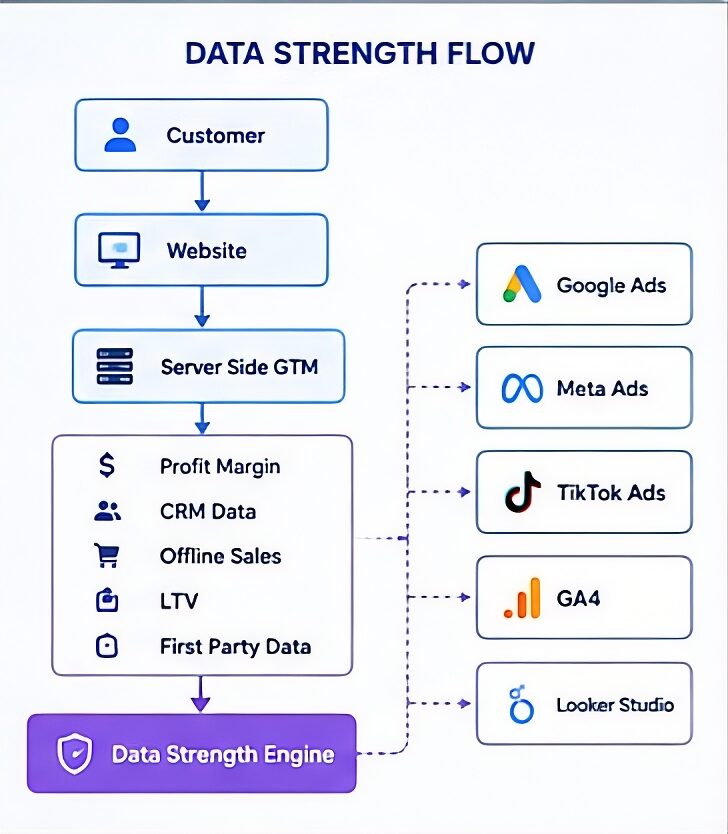
✓ Server-Side Tracking & Enrichment
✓ Consent Mode v2 + SHA-256 Hashing
Description
Your Server-Side Tracking Is Live. But Is It Making You More Profit?
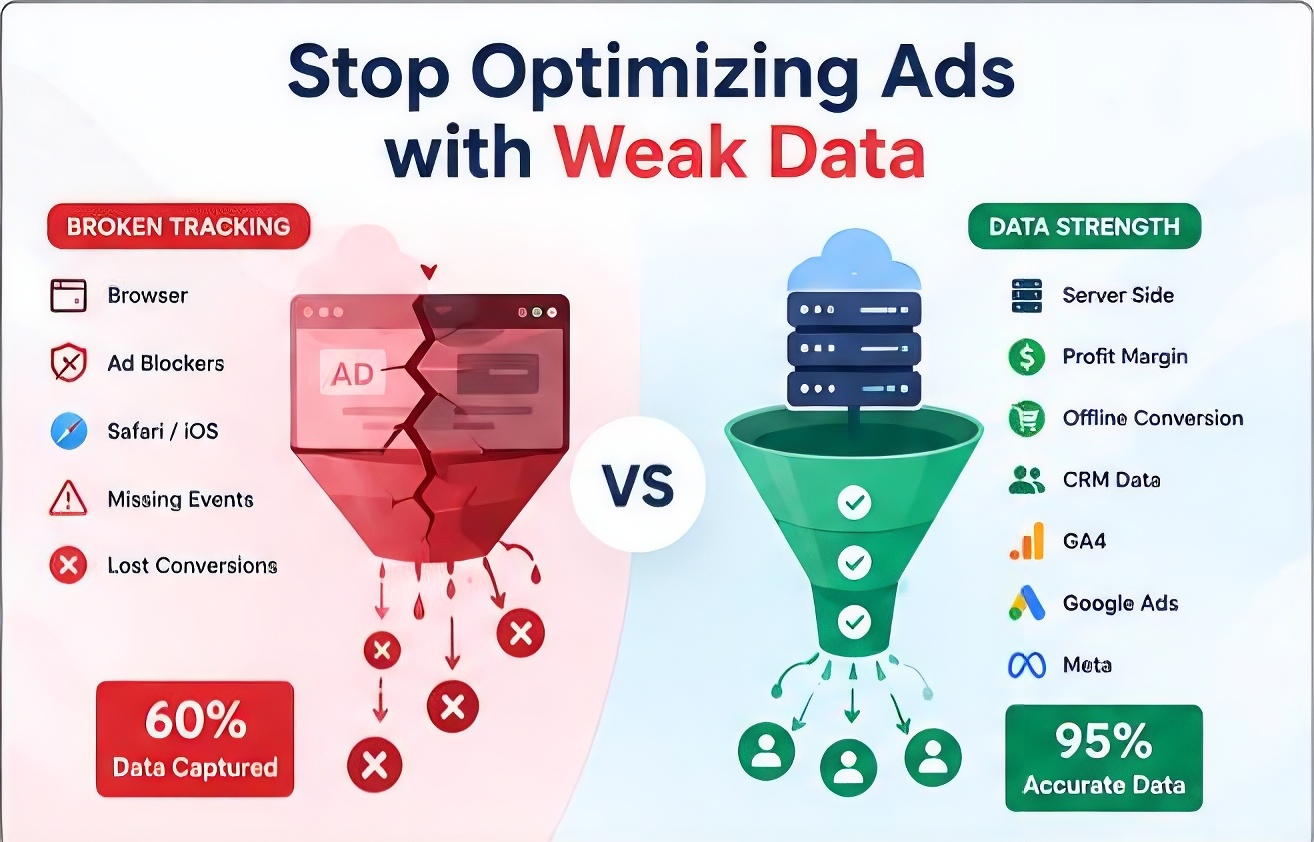
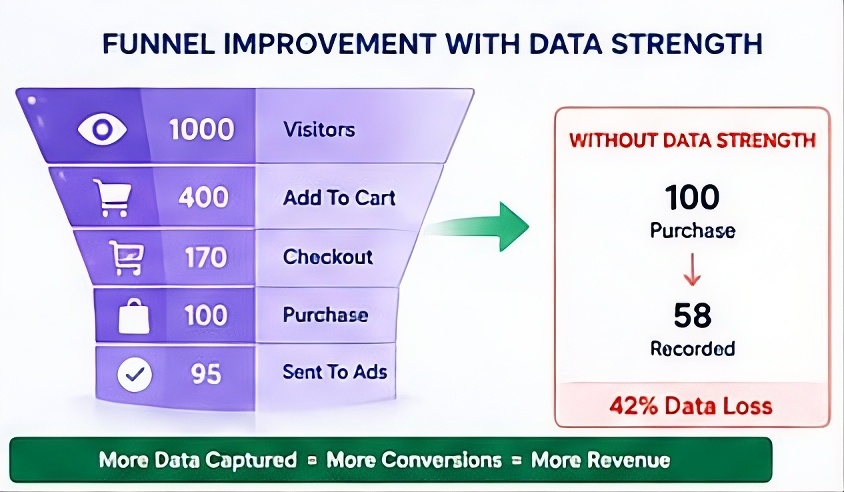
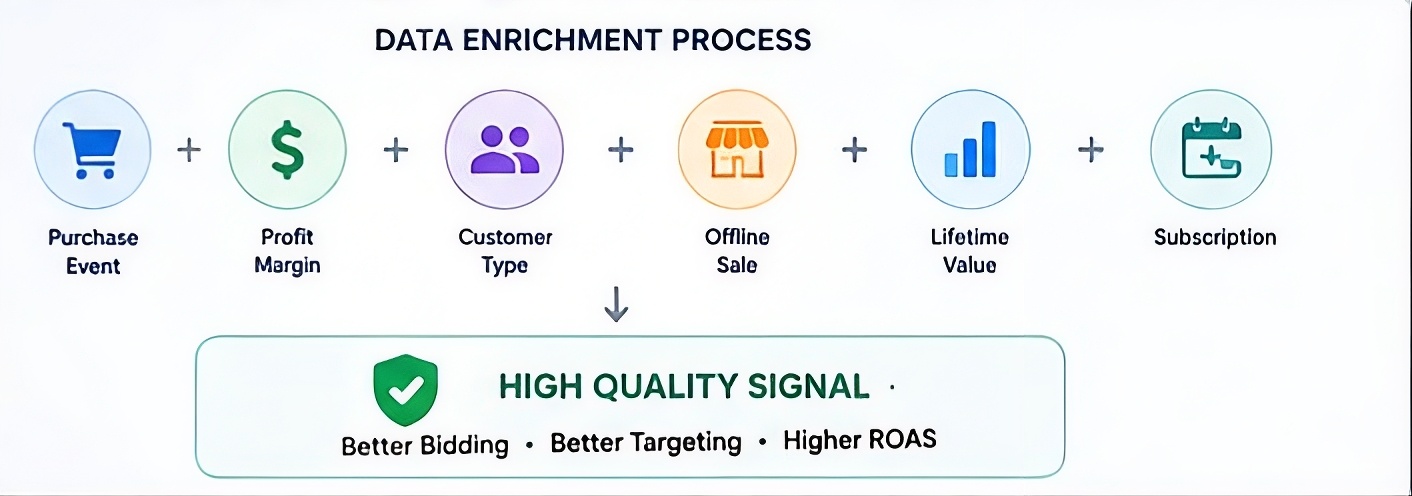
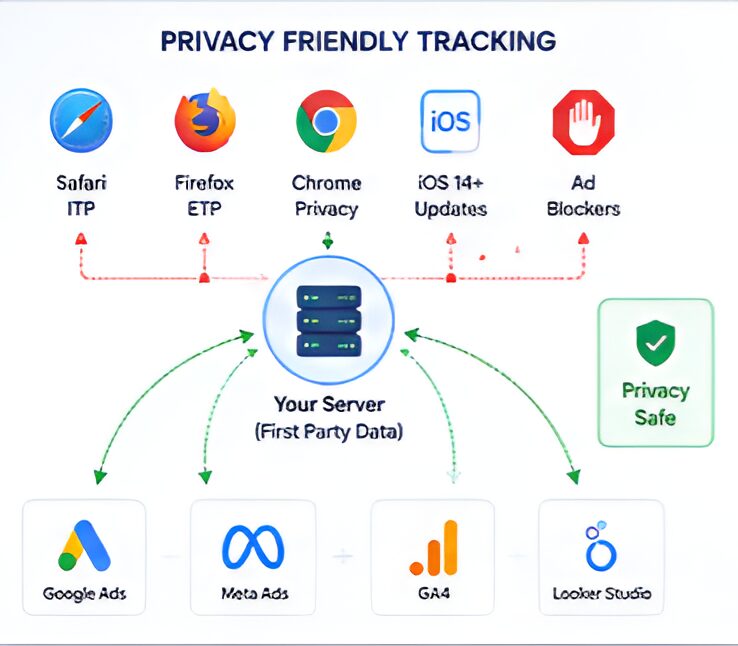
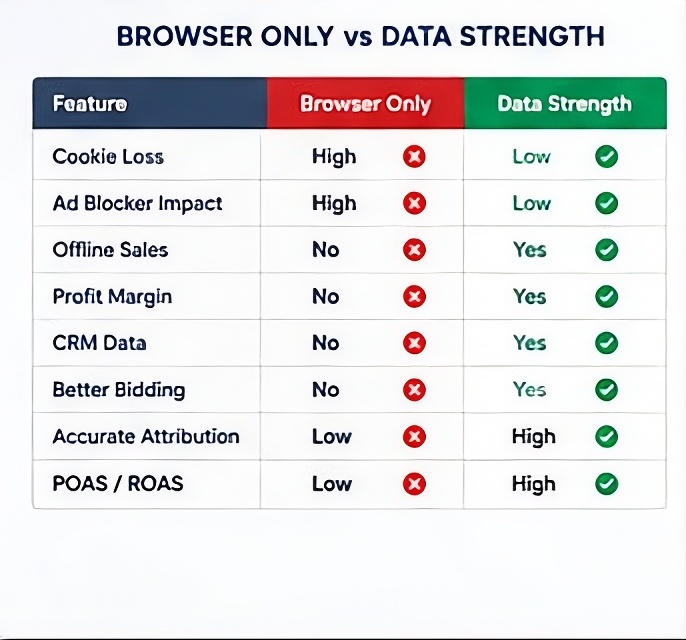
Most server-side setups are “dumb pipes” — they forward thin browser data to Google & Meta and stop there. Data Strength enriches your signals with profit margins, customer status, and CRM outcomes so ad platforms bid on what actually pays you.
"Dumb Pipes" Cost You Money
Your team (or agency) stood up a server, mapped a custom domain, and flipped the switch. You’re now officially “Server-Side.” But is your setup actually improving ROAS — or just acting as an expensive middleman?
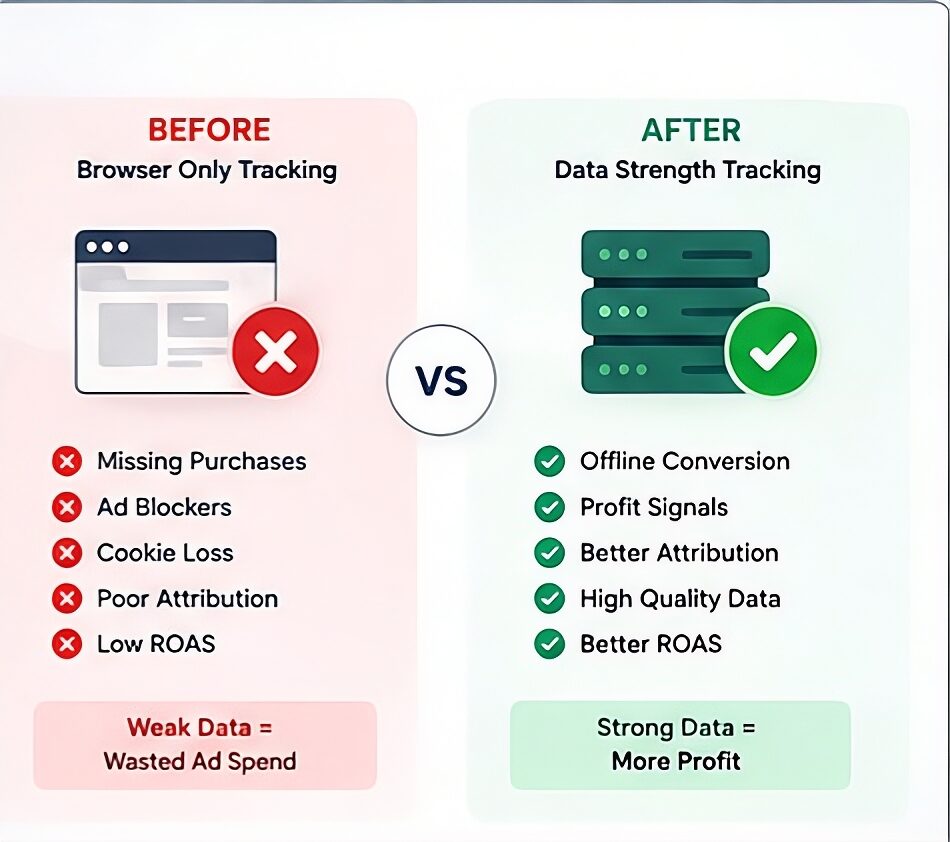
Most SGTM setups today are “dumb pipes”: they take thin data from the browser and proxy it to Meta or Google. You’re paying server costs to act as a middleman while feeding platforms the same flat purchase event they already got in 2020.
Ad platforms have evolved. It’s no longer about more data — it’s about the quality of signals. Sending plain revenue with conversions was enough in 2020. Today, that’s the baseline. When you feed platforms richer signals — profit margins, new vs. returning flags, CRM-based offline conversions — their algorithms find more of your best customers for less.
The cost of staying a dumb pipe:
Fix it now
✓
Ticket submitted
Our team will diagnose your issue and reach out to you shortly.
What Is "Data Strength" — And Why It Matters Now
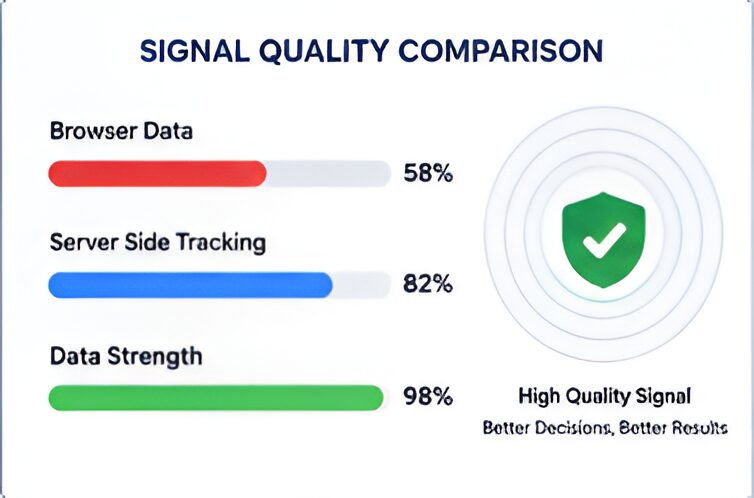
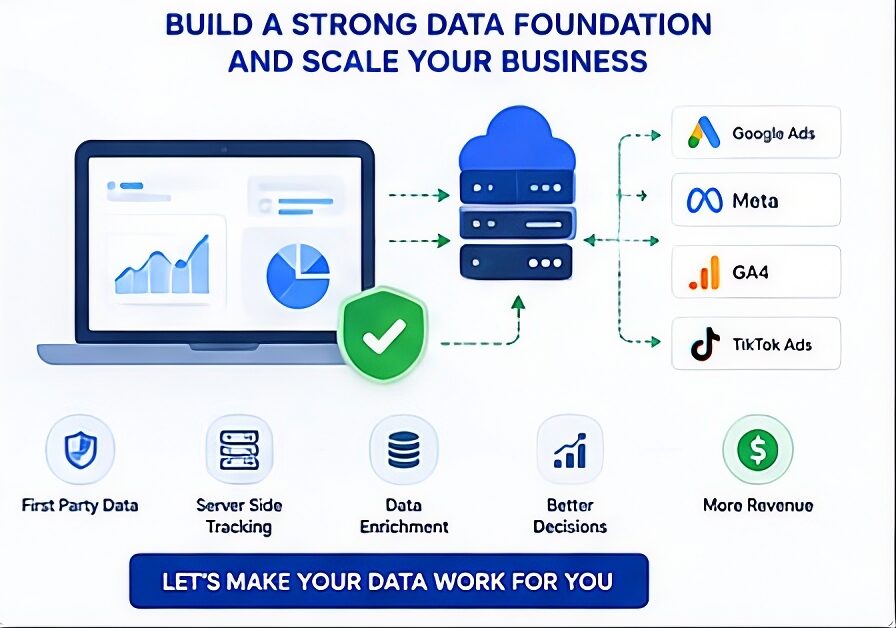
Data Strength is the quality and completeness of the signals you send to ad platforms and analytics from your own systems and touchpoints — via first-party data collection, server-side tagging, and enrichment.
High Data Strength means:
- You’re sending enriched, accurate signals (
new_customer,profit, CRM identifiers) instead of thin browser events. - Your offline and online data are connected so closed-won deals appear in Google/Meta for smarter bidding.
- You’re compliant by design — you control what leaves your server and handle consent and hashing properly.
Why now:
iOS / Safari ITP keeps pruning client-side cookies, making durable first-party server-side pipelines essential — not optional.
Platform priority: Google and Meta increasingly favor advertisers who send high-quality first-party signals — better match rates, more modeled conversions, higher bids.
The pipeline below is what “strong data” actually looks like end-to-end — from your backend to a smarter bid decision:
Backend / CRM
Orders
Margins
LTV
Margins
LTV
➜
Retrieve & Store
First-Party
Data Layer
Data Layer
➜
Enrich
Profit
Customer Status
CRM
Customer Status
CRM
➜
Hash & Consent
SHA-256
Consent V2
Consent V2
➜
Sync
Google Ads EC
Meta CAPI
Meta CAPI
➜
Smarter Bidding
tPOAS
Value Based
Value Based
➜
Profitable Growth
+40% Profit
-58% CAC
-58% CAC
The two steps most brands skip — Enrich and Sync — are exactly where Data Strength lives. That’s what this service builds.
Pillar 1 — POAS: Profit Over Ad Spend
ROAS tells you revenue. POAS tells you profit. When you feed gross profit — not just revenue — into Google and Meta, their bidding algorithms stop chasing high-revenue, low-margin orders and start chasing orders that actually grow your bottom line.
The payoff (sourced benchmarks already on your audit page):
- +40% net profit increase from POAS optimization — Portivo
- −58% acquisition cost reduction from sending profit data — Demand More
- Up to −60% ad spend saved after switching to profit-based bidding — Profitmetrics
- +9% ROAS increase from sending new-customer data alone — Google
What we actually do under POAS:
- Profit data layer — wire your product margin (COGS, shipping, transaction fees, refunds) into the data layer so every
purchaseevent carries a trueprofitvalue, not justvalue. - Server-side enrichment — inject
profit,new_customer,returning_customer, andorder_margininto GA4, Google Ads, and Meta CAPI payloads inside your SGTM container. - tPOAS bidding setup — transition Google Ads from tROAS to profit-based bidding (via custom conversion value or Profitmetrics-style feed) and mirror it in Meta with value optimization.
- POAS dashboarding — a Looker Studio / GA4 dashboard that shows POAS by campaign, product, and channel so you can pause the “high-ROAS, low-profit” campaigns quietly draining margin.
- Profit data layer — wire your product margin (COGS, shipping, transaction fees, refunds) into the data layer so every
Pillar 2 — Offline Conversion Tracking: Close the Gap Between Clicks and Cash
Your ad pixels only see part of the story. Offline conversion tracking pushes the truth from your CRM, CMS, or ERP back into Google and Meta — so when a lead becomes a closed-won deal, a subscription renews, or a high-value order ships, the platform learns from the real outcome instead of pixel noise.
Google itself now recommends starting with Enhanced Conversions for Leads (an upgraded form of offline conversion import that uses hashed user-provided data like email to attribute conversions back to the ad click) — exactly the pipeline Data Strength stands up.
Four reasons this changes your bidding overnight:
① Higher match rates. Hashed emails/phones from your backend match Google’s signed-in users far better than cookies — typically 55–70% in the US, the threshold where Smart Bidding visibly improves.
② Recover lost conversions. Server-side + enhanced conversions routinely recover 40–45% of conversions lost to iOS ITP, cross-device journeys, and ad blockers. Stop feeding blind bid strategies.
③ Smarter value-based bidding. When CRM deal values (not flat revenue) flow back as conversion value, Google’s tROAS and Meta’s bids chase your most profitable customers, not just any converter. A real-world multi-account experiment by Workshop Digital found Enhanced Conversions delivered a +16% average lift in measurable leads plus clearer attribution.
④ Privacy-safe by design. SHA-256 hashing on your server means user data (email, phone) reaches ad platforms without exposing PII — keeping you fully GDPR/CCPA compliant and Consent Mode aware.
What we actually do under Offline Conversion Tracking:
CRM/ERP webhook → secure storage → SHA-256 hashing → Google Ads Enhanced Conversions for Leads + Offline Import → Meta CAPI — fully deduped against your pixel events so you never double-count.
What's Included in the Data Strength Engagement
A clear deliverables list (mirrors the ✔ style on your other service pages so it feels native):
✔ Data Strength Audit (free, Loom, 48h)
Enrichment check — are events enriched or just forwarded?
Dumb-pipe detection — is SGTM adding value or just proxying?
Offline conversion sync gap analysis
Consent & hashing review (GDPR / CCPA / Consent Mode v2)
Backend-to-pixel gap analysis (margin, LTV, repeat status)
Prioritized fix list — what to fix first, what to hand to a dev
✔ Profit Data Layer (POAS)
Margin feed wiring (COGS, shipping, fees, refunds)
profit + new_customer injection into GA4 / Google Ads / Meta
tROAS → tPOAS bidding transition
POAS dashboard (Looker Studio)
✔ Offline Conversion Tracking
CRM → Google Ads Enhanced Conversions for Leads
Offline Conversion Import (gclid + hashed email)
Subscription/renewal value sync
Deduplication against pixel events
✔ Server-Side Enrichment Hardening
SGTM container rebuilt for enrichment (not proxying)
HTTP lookup / webhook variables for real-time enrichment
Consent Mode v2 Advanced mode aligned with hashing
✔ Privacy & Compliance Layer
SHA-256 hashing validation
Consent gating on every enriched payload
Data retention & deletion workflows
Client ReviewsWhat clients say after fixing
What clients say after fixing
their tracking.
Real reviews from Fiverr & Upwork. No screenshots — just the actual words.
FIVERR
★★★★★
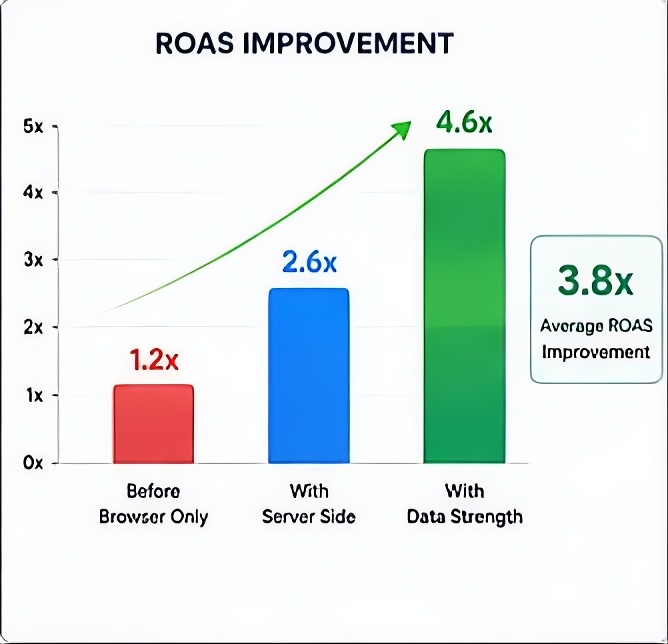
Fixed my server-side GTM setup for Shopify. Facebook ROAS jumped from 1.4x to 3.6x within weeks. Incredible work.
S
Sarah M.
Shopify Owner · 🇬🇧 United Kingdom
UPWORK
★★★★★
After adjusting TikTok tracking, conversions became visible for the first time. This completely changed our business. Highly recommended.
R
Ryan K.
E-commerce Director · 🇺🇸 United States
FIVERR
★★★★★
Compared GA4 with Shopify data and found hidden tracking issues I didn't even know existed. Everything was optimized perfectly.
A
Aisha T.
Digital Marketing Manager · 🇦🇺 Australia
FIVERR
★★★★★
"I have worked with Bipin many times and he always does an exceptional job. Thank you!"
R
roylipski
REPEAT CLIENT
🇺🇸 United States · 1 month ago
FIVERR
★★★★★
"Bipin is highly professional, completed GTM & multiple tracking configurations. Second time working together — 3-month warranty included. Communication makes all the difference. A reliable, professional partner!"
D
deepinvogueroma
REPEAT CLIENT
🇷🇴 Romania · 2 months ago · 4 days delivery
FIVERR
★★★★★
"Extremely thorough and knowledgeable of FB ads tracking and willing to troubleshoot if not working and figure it out until it works. Really appreciated his helpfulness."
R
robbleleman
🇺🇸 United States · 10 days delivery
FIVERR
★★★★★
"Bipin and team delivered the project efficiently with timely communication. Thank you and looking forward to working together again in the future."
L
letterbox4you
🇬🇧 United Kingdom · 4 days delivery
FIVERR
★★★★★
"Thank you for handling the Pinterest API connection. Would definitely recommend this freelancer to anyone needing tracking setup help."
K
kkelan55
🇺🇸 United States · 2 months ago · 1 day delivery
FIVERR
★★★★★
"Strong technical foundation and highly professional. Integrated Microsoft UET & multiple tools, provided a demo to ensure no loopholes. Efficient delivery and polite team."
A
amdebfre
🇺🇸 United States · 1 month ago · 4 days delivery
🚀 Want to Discuss This First! Book Your Tracking Transformation Call!
Take advantage of 95% Accurate Ads Conversion Tracking Setup for Website and unlock the true potential of your ads. Tap into advanced insights that most eCommerce stores will never access.
I am available here!
Find Me On
2500+ Projects Completed

35+ Projects Completed

10+ Projects Completed

55+ Projects Completed

FAQS Data Strength
What exactly is a Data Strength Audit?
A focused review of how well your tracking and server-side setup enriches and sends first-party signals to ad platforms. We check for missing enrichment, offline sync gaps, consent/hashing issues, and “dumb pipe” proxies that aren’t adding value.
Do I need POAS data ready before the audit?
No. Part of the audit is identifying where your margin data lives (Shopify metafields, ERP, a Google Sheet) and the cleanest way to pipe it into your tracking. We’ll flag the gap and the fix path.
What's the difference between Enhanced Conversions and Offline Conversion Tracking?
Enhanced Conversions enriches web conversions with hashed user data for better matching. Offline Conversion Tracking pushes backend outcomes (CRM closed-won, renewals) back to ad platforms. Data Strength sets up both — and dedupes them so you don’t double-count. Google recommends starting with Enhanced Conversions for Leads, which is an upgraded form of offline import.
We're B2B / lead-gen, not ecommerce. Does POAS apply?
POAS in its classic form is ecommerce-focused, but the same principle — feeding value (deal size, MRR, LTV) instead of flat conversion counts — applies. We tailor the engagement to value-based bidding for leads.
Is this really free?
Yes. The audit is a recorded Loom walkthrough within 48 hours — no sales call, no strings attached.
What if I don't have server-side tagging set up yet?
We’ll still audit your current setup and flag exactly where server-side + enrichment would have the biggest impact, so you can prioritize investment.